Why You Should Protect
Your Linux Server Data
Linux servers form the backbone of modern infrastructure, hosting critical databases, web applications, and essential services that drive business continuity. Yet a single catastrophic event can cripple operations: a ransomware attack encrypting your files, a hardware failure with no redundancy plan, an accidental deletion of mission-critical data, or a cyber breach stealing sensitive information.

Permanent Data Loss on Linux Infrastructure
Ransomware, hardware failures, and accidental deletions on Linux servers result in irreversible loss of critical application data, databases, and configurations with no recovery path.

Lack of Rapid Recovery for Linux Servers
Without reliable backups, restoring failed Linux servers stretches from hours into days or weeks, causing prolonged downtime and cascading service failures.

Manual Backup Script Failures
Complex cron jobs and shell scripts managing Linux backups are prone to human error, missed schedules, and unencrypted data exposure across your infrastructure.

Undetected Backup Failures Across Linux Systems
Manual sync and tar-based backups lack centralized verification, so corrupted backups go unnoticed until disaster strikes your Linux infrastructure.
Product Overview
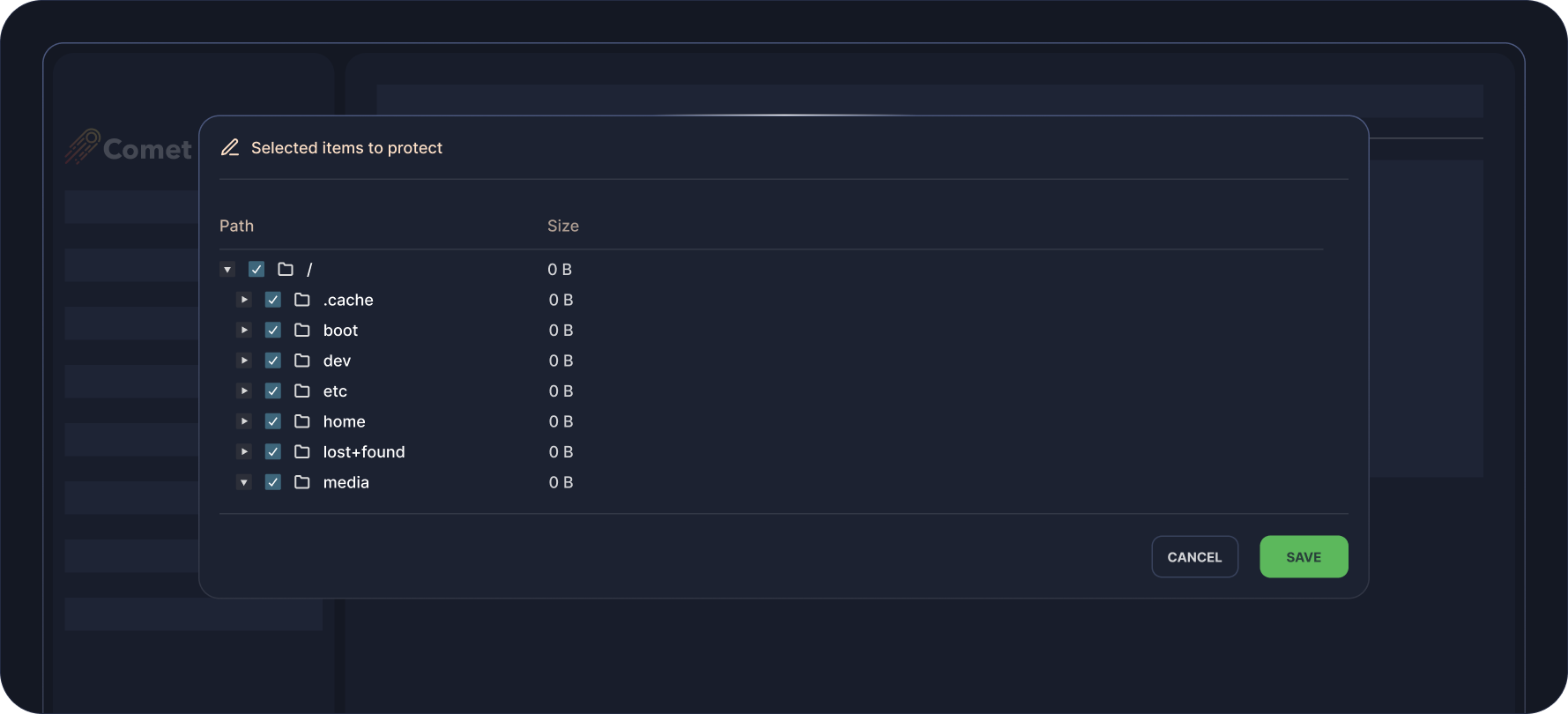
Linux File and Folder item selection window.
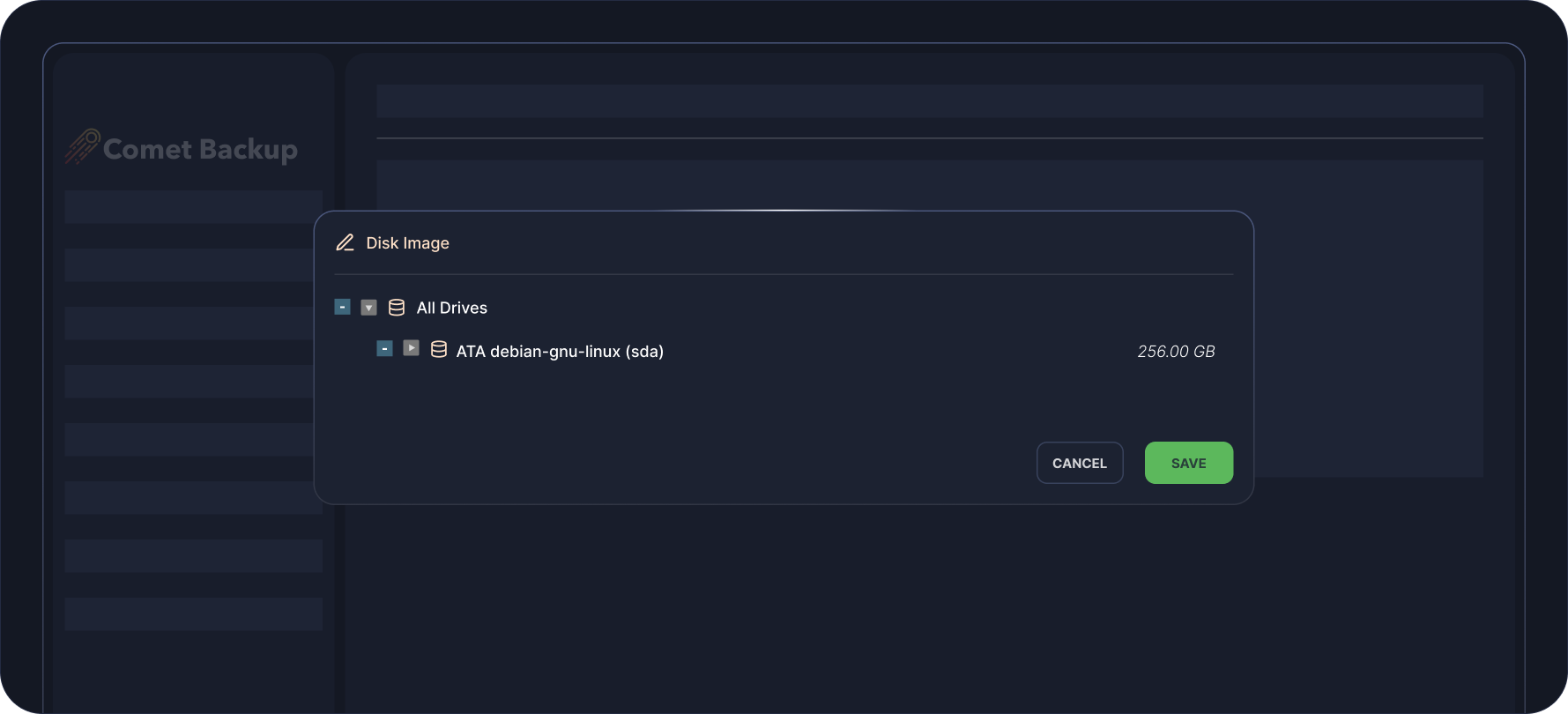
Linux Disk Image item selection wizard.
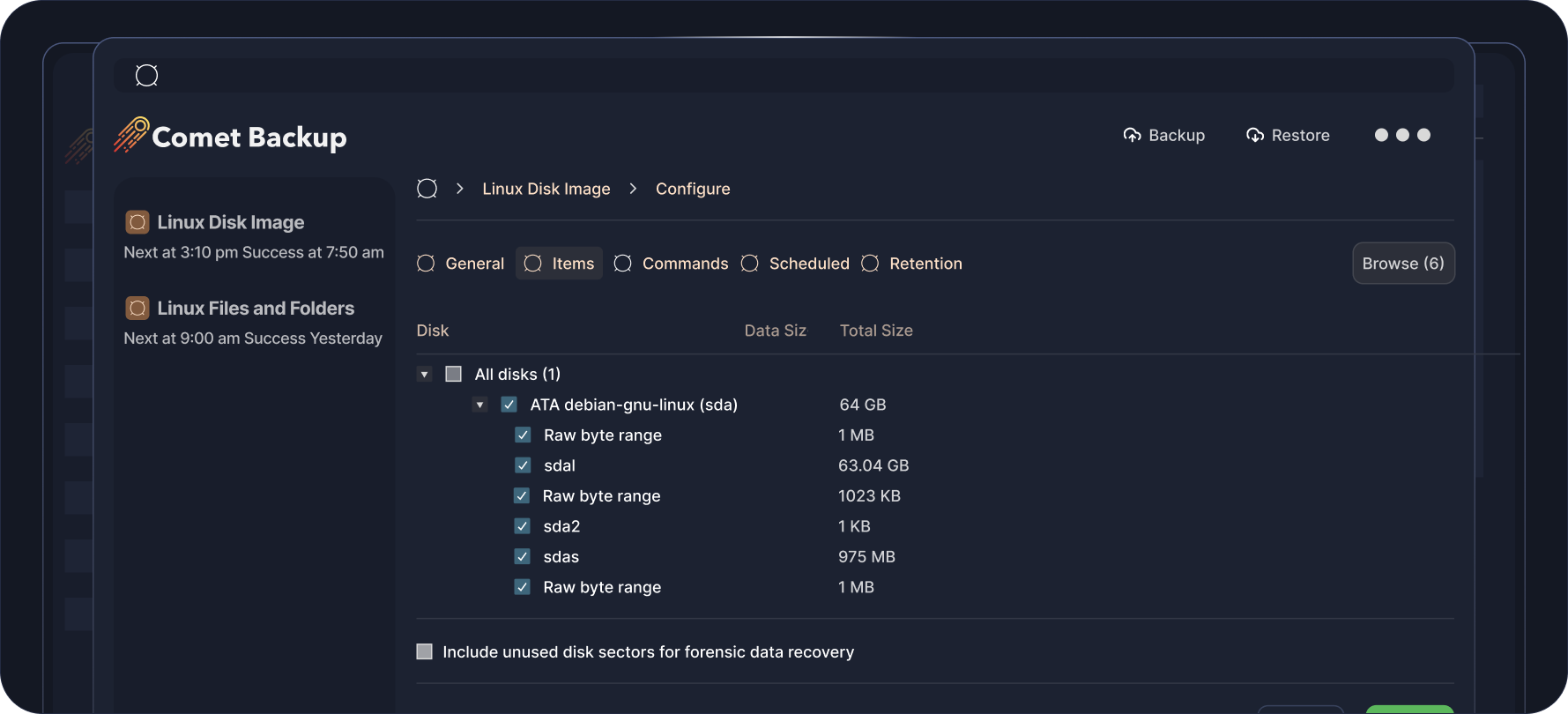
Linux Disk Image item selection wizard (agent)
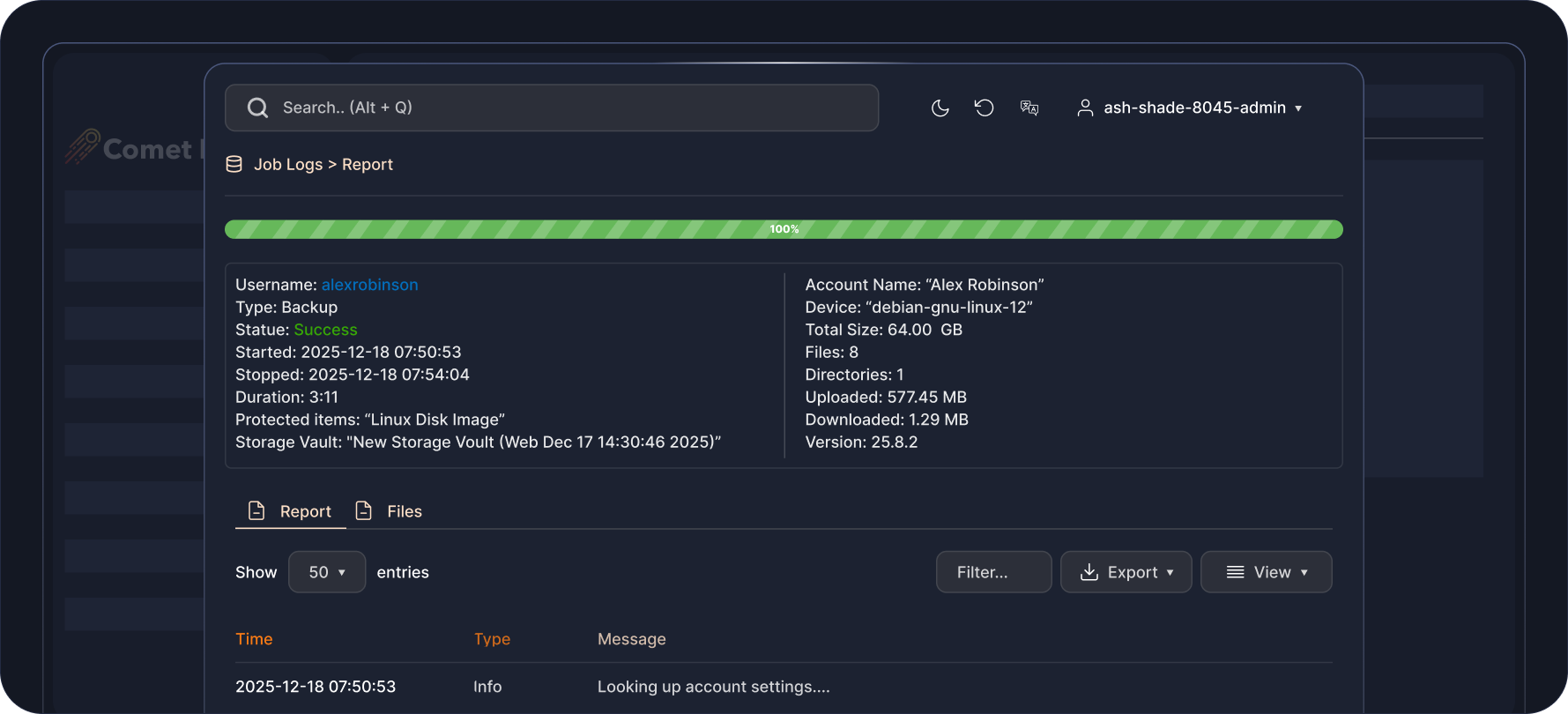
File an Folder job log showing file size, duration, etc
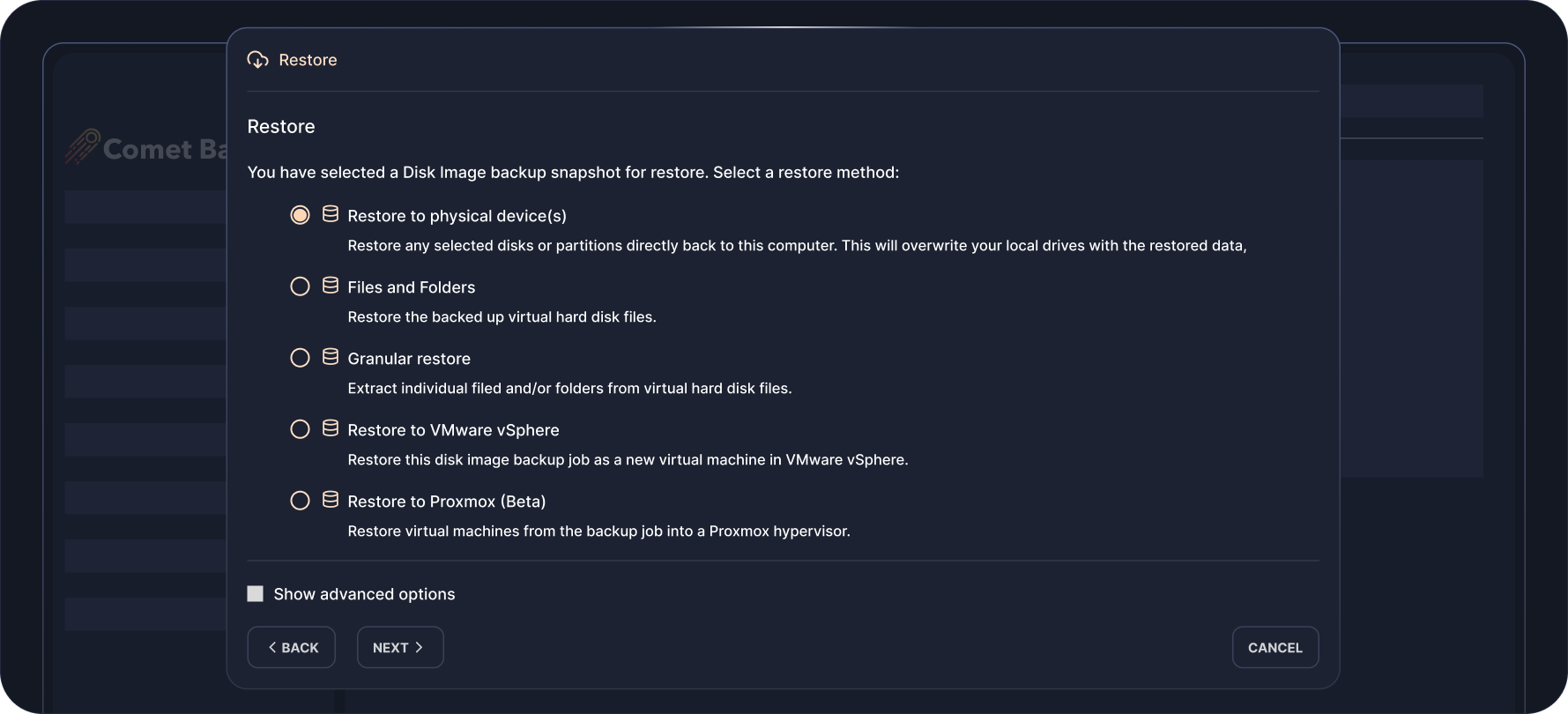
Disk Image Restore options
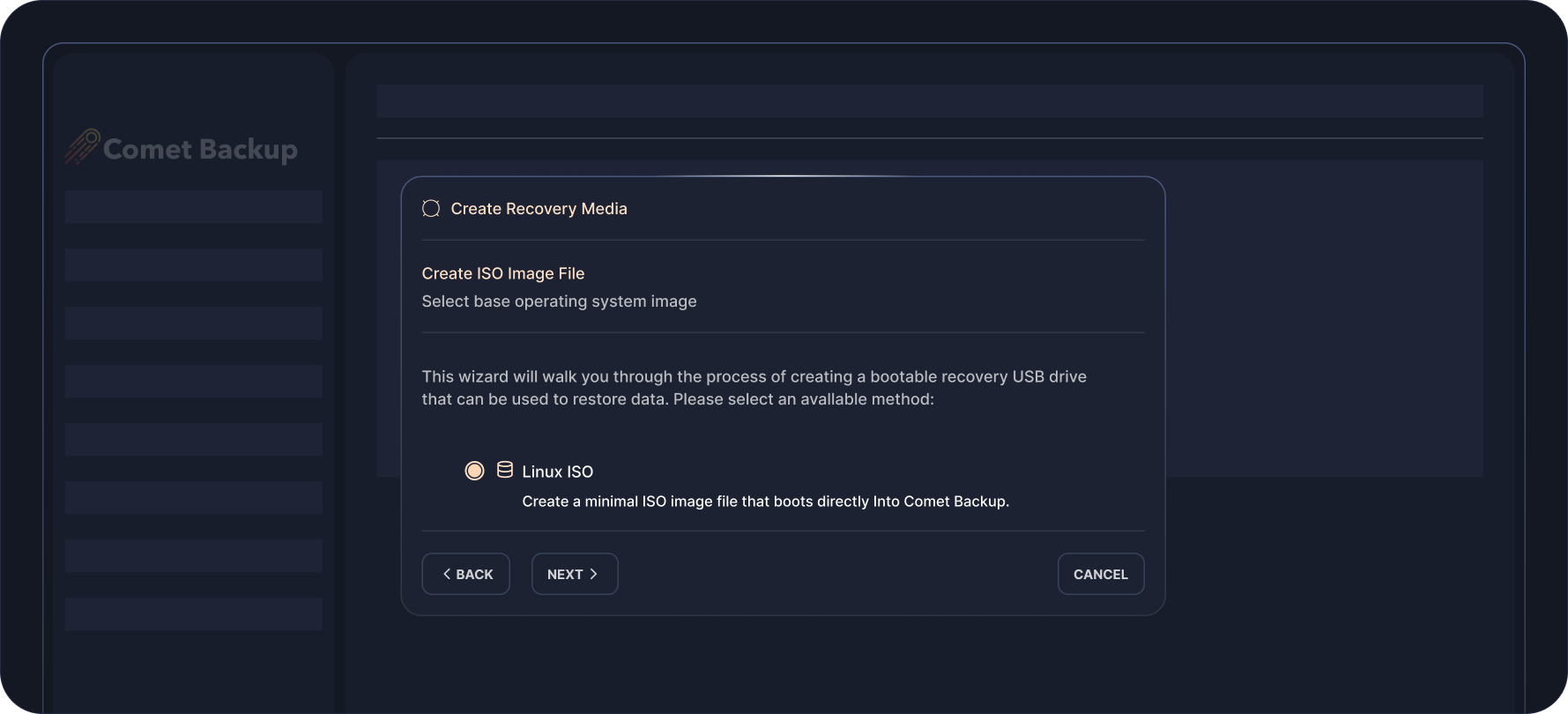
Disk Image create a recoverable media (only available on client interface)
Full Image Linux Server Backups
for Complete System Protection
Comet Backup offers powerful full Disk Image backup functionality, enabling complete system protection for Linux and Windows platforms. Unlike traditional file-level backups that capture only selected data, a Disk Image backup protects your entire system, including the operating system, applications, settings, and partitions, ensuring fast and reliable disaster recovery.

Full-System Protection
Capture a complete snapshot of your machine, so you can restore everything exactly as it was, from boot records to installed programs.

Bare-Metal Restore
Recover an entire system from scratch onto new hardware or a virtual environment without needing to reinstall the OS.

Flexible Recovery Options
Restore entire drives, or use granular restore options to recover individual files and folders to access key data quickly in a disaster scenario.

Business Continuity
Minimize downtime by quickly restoring mission-critical systems after hardware failure, ransomware, or accidental deletion.
Full-System Protection
Capture a complete snapshot of your machine, so you can restore everything exactly as it was, from boot records to installed programs.
Bare-Metal Restore
Recover an entire system from scratch onto new hardware or a virtual environment without needing to reinstall the OS.
Flexible Recovery Options
Restore entire drives, or use granular restore options to recover individual files and folders to access key data quickly in a disaster scenario.
Business Continuity
Minimize downtime by quickly restoring mission-critical systems after hardware failure, ransomware, or accidental deletion.


File and Folder Backups
for Quick Linux Data Recovery
Comet Backup makes it simple and reliable to protect important data at the files and folders level across Linux, Windows and macOS systems, giving users precise control over what they back up across multiple operating systems. This backup type is ideal for ensuring critical documents, media, and configuration files are always safe without the need to capture an entire system image.

Granular Control
Choose exactly which files and directories to include or exclude for optimal performance and storage efficiency.

Cross-Platform Support
Unified backup experience for all major operating systems including Linux, Windows and macOS.

Incremental Forever Backups
After the first run, only changed or new files are uploaded, reducing bandwidth usage and speeding up backup times.

Fast Recovery
Restore individual files or entire folders within minutes, either to their original location or an alternate destination.
Flexible Pricing That
Scales With You
Pay only for what you use. Add licenses and storage as your business grows.

Professional
Starting from $49 USD / monthBest for: Growing MSPs or larger IT teams.
All-in-one cloud solution to back up your data. No infrastructure requirements.
-
 1 Comet-Hosted Management Console License included
-
Starting at $2 / endpoint / month
-
Backup to cloud storage
-
Automatic startup & maintenance
-
No hardware required

Advanced
Starting from $99 USD / monthBest for: Backup resellers, VARs, or MSPs at scale.
Versatility for backup deployments across multiple environments with varying requirements.
-
5 Management Console Licenses included (Comet-Hosted and/or Self-Hosted)
-
Starting at $2 / endpoint / month
-
Backup to cloud or on-prem storage
-
Advanced security controls & access controls
-
Audit logging

Enterprise
Contact us for pricingDo you have custom backup requirements?
Talk to us for a comprehensive solution that meets your needs at scale.
-
Management Console Licenses based on enterprise volume
-
Endpoint pricing based on enterprise volume
-
Backup to cloud or on-prem storage
-
Advanced security controls & access controls
-
Audit logging
-
Air-Gap Management Console licensing option
Enterprise
Contact us for pricingDo you have custom backup requirements?
Talk to us for a comprehensive solution that meets your needs at scale.
-
Management Console Licenses based on enterprise volume

Watch It In Action
See how easy it is to set up and recover your Linux Servers data in this short demo.
FAQS
Comet backs up files, folders and system image on Linux servers, ensuring business-critical documents, files, and system data are restorable for business continuity.
Comet supports different restore types for Files and Folders as well as Disk Image backups, such as granular restore of files and folders for quick recovery of specific items, or a full image restore, among others.
Yes. The Management Console is your single-pane-of-glass console, allowing you to configure device and backup settings remotely from a web interface, as well as monitor backup statuses and initiate restores.
Comet supports storage destinations such as cloud storage (Comet Storage, Wasabi, Google Cloud), on-prem and off-site storage. Click here to find out more.
Comet supports multiple Linux distributions, such as Debian, Ubuntu, RHEL, CentOS and others. Check out the requirements here.
RESOURCES



ready for take off?

Sign up for our free 30 day trial