COMETCON
NOV 8, 2025
The Real Impact of Encryption on Cloud Backup Speed
Discover how AI-driven forecasting in Comet Backup helps MSPs prevent data loss before it happens.
Written by Callum Sinclair – Product Engineering Manager.
Bare-Metal backup and restores for Linux is now available in Comet 24.9.8 or later. With Linux Disk Image you can protect all of your Linux devices and eliminate the hassle of reinstalling and configuring devices from scratch when a disaster occurs.
If you’d like to watch a video guide of our Disk Image Protected Item, check it out here.
When setting up Linux Disk Image, you are able to choose what disks and/or partitions you want to protect. Once you’ve selected what you’d like to protect, all of the data is deduplicated, compressed, and encrypted as it is backed up on the fly. This means all of your data is secure as it is uploaded and less storage space is used to store the backup.
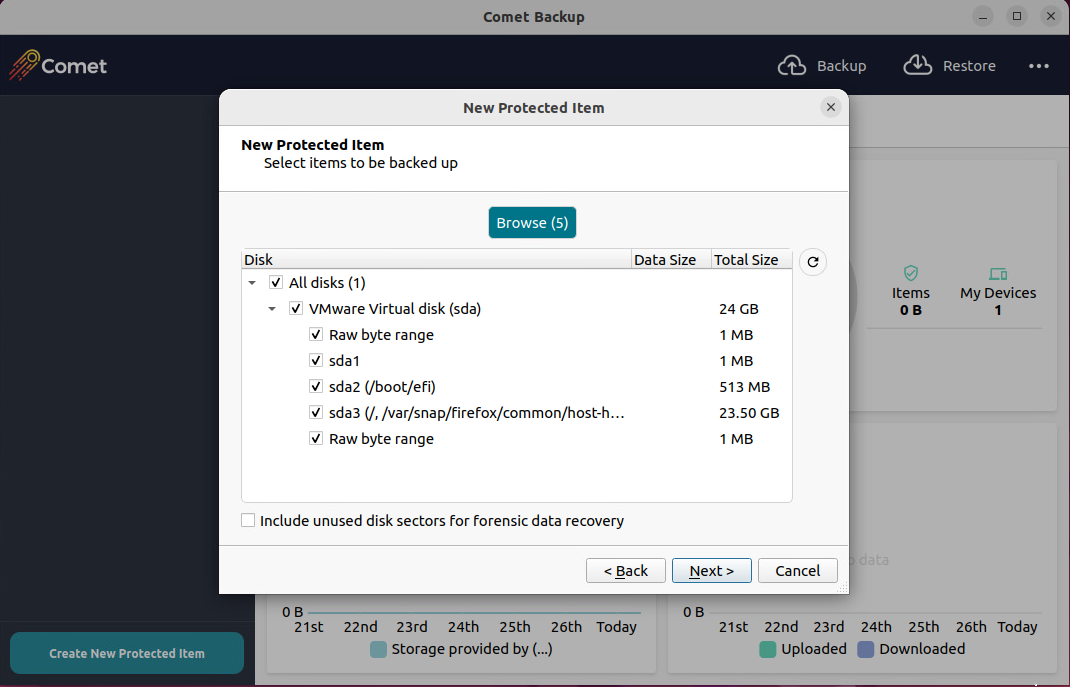
Backing up your Linux endpoints with Linux Disk Image does not require any additional storage space for spooling (temporary storage). The snapshot of the disk is taken and uploaded without the need for additional temporary storage drives.
To get started backing up your Linux devices, all you need to do is download and install Comet on the device and configure a Disk Image Protected Item.
backupsnap61 is a custom Linux kernel driver provided by Comet that can snapshot any block device. If it is installed, it will be used to snapshot the block device for backup.
The benefit of installing our custom backupsnap61 driver is:
Before the custom backupsnap61 driver can be installed, your Linux device will need to be running Kernel 5.9 or later and have <a href="https://en.wikipedia.org/wiki/DynamicKernelModule_Support”>Dynamic Kernel Module Support (DKMS).
A copy of the backupsnap61 installer is bundled with Comet Backup. To install this driver, simply run ./backupsnap61-install.sh from your Comet Backup install directory.
Comet can also take disk snapshots using other methods, which is covered in our docs here.
Once a Disk Image backup has been taken for your Linux device, you have the flexibility to restore data in one of the five following ways:
To assist with restoring to a physical Linux endpint, a bootable Linux recovery environment with Comet pre-installed can be created and written to a USB.

After the USB has been created, all you need is to plug it in to the physical machine you want to restore the data to and boot from the USB. Then you can use Comet to select where you’d like to restore the data to. To learn more about restoring a Disk Image backup to a physical machine you can check out our docs here or our walkthrough here.
Adding Disk Image for Linux was a highly upvoted request from our Feature Voting system. We encourage you to check out this system and let your voice be heard – at the time of writing, we have completed over 180 user feature requests. Your votes are one of the things we take into consideration when building our product roadmap.


Discover how AI-driven forecasting in Comet Backup helps MSPs prevent data loss before it happens.
Discover how AI-driven forecasting in Comet Backup helps MSPs prevent data loss before it happens.

Discover how AI-driven forecasting in Comet Backup helps MSPs prevent data loss before it happens.
Discover how AI-driven forecasting in Comet Backup helps MSPs prevent data loss before it happens.
Discover how AI-driven forecasting in Comet Backup helps MSPs prevent data loss before it happens.
Discover how AI-driven forecasting in Comet Backup helps MSPs prevent data loss before it happens.